
All Posts
BGC Micro-Microcredentials!
Brandeis University is furthering its plan to reinvent the liberal arts by launching their new microcredentials for undergraduates. With this new opportunity, students will be able to earn each of five new microcredentials by taking 2-3 corresponding courses for each category, along with an assessment for each. The five new microcredentials are: Applied Statistical Analysis, Foundation of Data Analytics, Person-Centered Research and Analysis, Policy Analysis and Implementation, and Sound and Video Media. Or, in simpler terms: science, math, humanities, politics, and film. This exciting new feature of the Brandeis curriculum allows students to add a new goal to their already busy schedules by taking an assessment to prove they have basic skills. Or, students could simply copy these buzz word microcredential titles into their resumes without any extra work! That’s a BGC life hack!
Brandeis’ goal to reinvent the liberal arts is part of a move to make the curriculum more workforce relevant, providing students with the resources they will need to succeed after graduation. With today’s competitive job market, graduating students are experiencing uncertainty about their futures, especially those with useless English degrees. Other universities are combating this issue with intensive internship programs like Northeastern’s co-op program, which requires students to gain real work experience for a semester. Brandeis however, always looking for new ways to innovate, has taken a slightly different approach by focusing on how to make liberal arts students marketable in the real world. Because, of course, the AI software screening everyone’s resume before it gets to a real hiring manager is really going to be impressed by the made up badge you put on your LinkedIn profile. Who needs hands-on experience when you can have five new made up skills on your resume! Skills that, by the way, could be reasonably assumed by any employer (or AI) who sees you have a degree. But perhaps Brandeis is right, maybe it matters less that you’re qualified for a job, and more that you sound qualified. Any moron can get a job as long as their resume sounds like it was written with Grammarly.
Well, we at the Brandeisian Girls Club have found this idea so inspiring, that we have decided to provide a few of our own resume-boosters. These are based on the skills that we have found are particularly relevant to the average Brandeisian GirlTM. Feel free to use these micro-microcredentials on your resume when applying for internships this summer, and take the corresponding assessments to earn your badge! Club members only!
Methodical Sleuthing and Personal Analysis
Demonstrates the ability of a student to conduct exhaustive research on a subject and draw discerning conclusions based on their findings.
Humorous Analytical Interpretations
Reflects a student’s ability to provide farcical commentary based on topical situations in social, political, and otherwise droll contexts.
Foundational Principals in Allure
Certifies a quality of enticement that allows a student otherwise restricted connection to a wider network of resources.
Implementation of Misdirection and Stealth
Demonstrates a student’s ability to execute covert transactions with the outcome of an acquisition of required effects.
Foundations in Analysis and Reasoning
Reflects the student’s logical means of processing high volumes of data, broadly in the matters of trivial or otherwise straightforward facts.
Decorate Your Dorm… Get a Dessert!
BGC Travel Blog #1: A Guide to Scottish Cuisine

Fàilte gu Alba! Oh, sorry, that’s Gaelic for “what’s up Brandeisians!” I’ve been living in Scotland for two months now, so sometimes I just slip into the language haha. I’m basically a native at this point, but adjusting to a new country does have its challenges. During my semester abroad I have experienced many cultural shocks, such as the archaic infrastructure and surplus of sheep. No matter how long I stay here, I don’t think I’ll ever stop having to count on my fingers to translate military time. Some things here remind me of home though, like the nice Scottish Trump supporters I met on the train who insisted on sharing their pickled onion Monster Munch crisps with us. Yes! Crisps being Gaelic for chips of course, and monster munch meaning inconveniently shaped puffs, and pickled onion meaning gross. Here’s a picture:

These surprisingly tolerable monstrosities bring me to my topic for today’s entry. Food! Adjusting to the food in a country known for mushy peas and haggis has been a challenge. At first I thought it was impossible. But I am writing now to tell you that if you are hungry enough, anything will taste good. Below is a list of my most notable food observations in Scotland. Bon Appetite! (That is Gaelic for “my stomach hurts”).
Fruit
I have eaten at least one apple per day for the past two months. In the US, I almost never eat an apple unless it is sliced. Not because I am 5 years old, but because the apples of the USA are too big and too daunting. This is something I have complained about for my entire life. So imagine my pleasant surprise when I get to the UK and all they have are perfectly snack sized apples! By far not the best apples I’ve ever had, they are pretty average in taste, but I appreciate how petite they are. Similarly, I have noticed that there is an insane amount of seeds in every mandarin orange I have had since coming here. Why is that similar you ask? Because these British fruits have not been genetically modified like the enormous and seed-barren fruits of the USA. People from the UK love to mock us for our unhealthy chemical-ridden GMO fruits, and I have to say they may have gotten us here. UK: 1, USA: 0. But this isn’t over. The UK’s obsession with responsible food standards will be a recurring theme here.
These are really the only two fruits I’ve eaten cause that’s all they have in my dining hall at St. Andrews. I had a banana too I guess but it tasted the same.
Candy
This is where I have a bone to pick with the UK’s Food Safety Administration. Every American candy, soda, or snack product on UK soil has been noticeably altered. Mock me for being a stupid unhealthy American all you want, but I expect a certain amount of chemicals in my sweets to give it that special flavor. The FSA hates fun however, and so you will not find any Red 40 or similarly delicious food dyes on any UK store shelves. Coca-Cola doesn’t give you the same burn in the back of your throat here. Cadbury chocolate doesn’t have that sour Hershey’s aftertaste. Even the American chocolate they do have doesn’t maintain its flavor, the M&M’s I had yesterday tasted like they were made with REAL cocoa powder? As I write this, I am eating a bag of starbursts, and every time I unwrap one I am disappointed by the dull beige color of a candy made with real fruit flavoring. I miss jolly ranchers! And I don’t even really like jolly ranchers! I just like knowing that if I wanted to I could walk into any store and turn my tongue blue and break all my teeth.
One thing that the UK does have plenty of on the candy aisle is Haribo gummies. There is an endless supply of different variations of Haribo, and most of them are weird and bad. For some reason at the Sainsbury’s near St. Andrews the normal gummy bears are separated from all the weird ones, like these people actually prefer the “Starmix” pack. I will admit that one has grown on me. I like the gummy egg and the gummy root beer. I would buy a bag of just gummy root beer but they don’t have that. They do however have a bag of “twin snakes” and other silly bullshit if you’re into that kind of thing. No Sour S’Ghetti like in the US though. Sigh.

Fish and Chips
Fried fish, chips (french fries), and peas (mushy or not) with a side of tartar sauce and a lemon wedge. 10/10. Really playing to their strength with this one, three bland foods, yet together, it just works. I would say I’ll be sad to lose this when I go back to America, but it is so easy to replicate you really don’t need to come here to try it. It’s the same if you get it in Boston. Still, good work lads, it’s a wee bonnie dish (Scottish slang translating to: pretty good!). Actually better than pretty good, I could probably eat this every day. It’s the kind of food a picky toddler would probably enjoy. Who doesn’t love a plain butter noodle?
Haggis
The most infamous Scottish dish… The hotdog of the British isles… To quote Queen Elinor in the movie Brave: “It’s just a wee sheep’s stomach! It’s delicious!” Yes, haggis is a Scottish dish traditionally made of the bad parts of a sheep, oatmeal, and onions stuffed in a sheep’s stomach to boil. I don’t think they actually use the sheep’s stomach anymore because the smell was too bad (at least that’s what my study abroad liaison Hamish told me). As unappealing as that may sound, it’s actually pretty good. I liked it. It tastes kind of how you would expect I think, but not bad. It’s really just like eating a hot dog, if you don’t think about what it’s made of, it’s just meat. If you’ve had lamb before, it’s not really like that. I give it a 9/10, I’m feeling generous. I can only imagine that back in the day in the highlands, coming home and seeing your mom has the sheep stomach out must have been the exact opposite of seeing your mom bring out the crockpot today. If you are passing through Scotland I definitely recommend!

Digestives & Biscuits
I got a little upset about the candy earlier, but one thing they really have mastered here is the art of the cookie, or as they call it here for some reason, a biscuit. Scotland actually invented the digestive biscuit, a cookie that helps with digestion, supposedly. They have those things everywhere, I actually haven’t had any. My digestion is fine. But that is just one of billions of types of cookies they have here. A personal favorite of mine is Jammie Dodgers, which I’ve been eating for years. If you get the chance, I suggest taking the train to Concord and going to their British candy store to pick some up while you’re at Brandeis. They also have these things called tea cookies and it’s like a shortbread base with a shit ton of marshmallow fluff on top covered in chocolate like some kind of inside out smore. Incredible invention! This is the land of tea and biscuits, so I expect nothing less from them. Truly revolutionary innovations happening in the UK for the cookie industry.

Potatoes
I am using this as a platform to declare my undying hatred for potatoes. I hate them so so so much. Every single meal in the dining hall here is served with fucking potatoes. Who plucked a gross starchy lump out of the ground, took a bite, and thought, “wow this is really great lets come up with 800 different ways to cook these and they’re all bad”? FUCK. YOU. But unfortunately, even though potatoes have been embraced by Ireland and Scotland, the Americas are really to blame for potatoes. UK: 0, South America: -1
Indian food
For very unfortunate reasons, there is a lot of really good Indian food in the UK. I will actually be devastated to lose this when I go home, but I am trading it for the complete lack of good Mexican food. And okay this isn’t Indian but there’s a shawarma place nearby that I go to almost every weekend that is probably better than any shawarma I’ve had before. I guess the reason for good Middle Eastern food is probably just as unfortunate as the Indian food though. Well, if you’re ever in Scotland and want seasoned food, I suggest visiting any Indian restaurant you stumble across, they are all good.
Toastie
Last on the list is the glorified British grilled cheese. A toastie is just a sandwich that they heated up. It can have anything on it, the other day I had one that was pickle, ham, cheese, and onion or something like that. It was pretty good but made my stomach hurt a little but that could’ve been from the coffee I had with it. This is another thing that the UK does really well that you can also get anywhere in America. But I will say I have seen some pretty crazy sandwiches here that I don’t think the American mind could comprehend. I had a really good one this morning that they called a “boxing day” toastie. It was ham, turkey, cheese, chutney, cranberry sauce, and stuffing. Basically Thanksgiving dinner toasted between two slices of bread! It was really good I love all of those things and I would have never thought to put cranberry sauce on a sandwich but I loved it. Another win for the UK! Nothing impressive, but charming. I will honestly probably be upset that I can’t find any cranberry sauce sandwiches back in the US.
So, if you are coming to the UK expecting good cuisine, you can at least expect it to be better than what is served in the Sherman dining hall! If you disagree with me on any of my opinions you are wrong and you can email me and I will tell you why you’re wrong. If you are Scottish and I have offended you I do not care. Tune in for future Brandeisian Girls Abroad content!
Wordsearch #1
“Majors at Brandeis that Matter“
Made by Ella Kulczar with the free word search builder from Amuse Labs
Reductive Slime Theory: Will it Slime: No Borax no Bowl?

Abstract
This week our scientists at the Brandeisian Girls Club Institute for Mad Science, or BGCIMS, tackled the until now unsolved scientific question of “can you make slime on the skyline common room tables (no borax no bowl)?”.
Our hypothesis: Yes you CAN make slime on the table of a skyline common room without borax or a bowl.
It took work, it took dedication, it took genius problem solving, it took trial and error, but by God our team was able to make a breakthrough in this scientific field that will change the way we see slime at Brandeis.
Theoretical Introduction
The activity of “making slime” became extremely popular in 2016 and the trend quickly spread globally until everyone (but not their mothers) wanted in on the experience. Making slime typically involves mixing together polyvinyl acetate glue and borax to create an interesting fluid that can be joyous to play with. The characteristic texture of slime is created by the polymers in the glue being linked together to create larger polymers. Slime, however, did not stay simple for long. Since its introduction to the scientific community many daring scientists have asked questions like “can I add my shaving cream to slime?”, “what happens if I dump an entire bag of beads into slime?”, “what will happen if I leave my slime uncovered in a bowl overnight?”, or “can I add clay to slime and if so will the texture be nice?”. These questions lead to the discovery of fluffy slime, crunchy slime, iceberg slime, and butter slime respectively.
These types of additions, however, have never been the main frontier of slime science. Slime science has for its entire history been far more focused on the act of removing ingredients from slime and investigating the effects. Our team at BGCIMS has coined this type of investigation as “Reductive Slime Theory”.
Reductive Slime Theory arose mainly from the fact that many people did not have some specific ingredients like borax in their home. This led to a huge uptick in trying to make slime with as few ingredients as possible or with the most exotic ingredients they could find. On June 1st of 2016 over 1 billion people in the US alone Googled: “How to make slime no borax no glue”. This line of investigation directly catalyzed the discovery of other slime activators* that could be used in place of borax. This includes laundry detergent and contact solution.
The study of Reductive Slime Theory unfortunately also became infested with frauds. Due to the ease of falsifying YouTube videos, thousands if not millions of creators sought out to dupe real slimers with fake recipes based on no scientific truth. Slimers were fooled into believing, for instance, that putting shampoo and salt into a sealed container overnight would result in perfect slime by morning. Slime scientists as a result have been working tirelessly to combat the false claims spread by slime scammers since 2016.
Since the slime craze has cooled down in recent years, slime scientists have been able to focus less on false recipes and more on making new breakthroughs.
The question our scientists have been investigating has plagued slime scientists since the birth of Reductive Slime Theory. Can you make slime, not JUST without borax, but also without a bowl? I’m sure you too, dear reader, have been kept up at night by this question, but fret no more. The BGCIMS has found irrefutable scientific proof that you can in fact make slime without a bowl, without borax, on a table in a Skyline common room here at our home of Brandeis University. Stick around to find out exactly how.
Materials
To make the results of this experiment as clear as possible it was our aim to use only a few simple ingredients. This is of course the usual aim of Reductive Slime Theory. In our case, using few ingredients also was helpful in identifying the ingredient that caused the formation of slime, with too many ingredients it would have been impossible to determine what ingredients or processes were responsible for the results. In order to replicate this experiment the following materials are required.
- 48 ounces of polyvinyl acetate glue (purchased from Hannaford’s Supermarket and Pharmacy)
- 12 fluid ounces of contact solution containing boric acid (purchased from Hannaford’s Supermarket and Pharmacy)
- Baking soda
Methods and Results
i) Setup
The start of our work began by emptying one 16 ounce bottle of our Elmer’s PVA glue onto our sterilized work surface (the table in the Skyline common room). A key property of this work surface is that it is large enough in both length and width such that when the glue is poured completely out it does not spill over the edge. Even with a large table, it was initially necessary to assign one researcher to the task of keeping the glue on the table.
ii) Activation Attempt 1
With ⅓ of the glue supply emptied onto the work surface, the task became activating the slime. For this experiment our initial hypothesis was that contact solution would be sufficient to activate the slime. One researcher added a splash of contact solution to the work surface and the researcher in charge of mixing agitated the slime until the solution was homogenous. This did not have any significant result.
This addition of a small amount of contact solution followed by significant mixing was repeated approximately 7 more times. The only observation made by our mixing researcher was that the fluid would seem to begin to coagulate for a few moments before melting back into the puddle. This caused us to try adding significantly more contact solution rather than just a dash. We added large amounts of solution twice. This still did not cause a reaction in the glue.
At this point our team became divided. There were two schools of thought on the matter of the contact solution*. Either:
- We were adding too much contact solution causing the slime to be over activated.
Or:
- We simply had not added enough activator and it was only a matter of time until the slime formulated itself.
We will now take a short time to discuss these two theories. Proponents of the first theory argued that we had now added “a fuck load” of contact solution. The idea behind the over activation theory relied on the fact that contact solution is a known slime activator and it is also well documented that too much solution can cause slime to melt. Since it is a known activator, proponents of this theory argued that it was unlikely that it had simply not worked and was far more likely that we had melted the slime.
The second theory, ironically, also relied on the fact that contact solution is a known slime activator. Proponents of this school of thought argued that since the solution would normally activate the slime before reaching the saturation point that would lead to melting. It was argued that since the slime had not yet activated, it could not possibly be over activated. The theory one backers countered with the fact that the glue had been observed to coagulate so some activation had clearly occurred.
These two schools of thought were not immediately able to reach a consensus. They did, however, come together to plan the next step.
iii) Operation Add More Glue
The motivation behind Operation Add More Glue was that regardless of which theory was correct in explaining the lack of activation, more glue was sure to solve the problem. If theory 1 was correct, more glue would help balance out the incorrect ratio between activator and polyvinyl acetate. On the other hand, if theory 2 was correct, more glue would not hurt the process, more activator would just have to be added to compensate. Both groups of researchers then agreed to add another 16 ounce container of glue to the work surface.
This new ratio was mixed for a time in order to ensure it was completely combined with the original glue and contact solution mixture. This mixing did not have any results.
Now that the threat of over activation had been successfully neutralized, our team gathered to discuss how to move forward in order to avoid the same problem occurring again. (This meeting of course did not include the team member responsible for keeping the glue on the table).
To move forward, our team made the potentially controversial decision to make a change and try a different activator. It was decided that we had determined that the contact solution had not been sufficient to activate this slime. Though we did not discover the exact reason for this failure, it was determined that it was more important for the success of this experiment that we stop backing a dead horse and move down a different path.
iv) The Search for a New Activator
Our team at this point brainstormed options for a different active ingredient. Laundry detergent was mentioned but discarded because it is expensive and no one on our team was willing to give up their detergent for this mad science mission.
At this crucial moment it was discovered that one of our researchers was in possession of a nearly full box of baking soda. This baking soda originated from an extra credit project assigned by Prof. Claudia Novak. Its original use was to be used to demonstrate the three gas laws. That little box of baking soda was about to take part in a 2nd scientific experiment. This was our new activator.
Our scientists decided to make the risky choice of using baking soda even though it has less peer reviewed slime recipes than contact solution.
v) Activation Attempt 2
Our scientists returned to the puddle of glue and sprinkled a tiny bit of baking soda into the fluid. The main goal here was to avoid over activation at all costs so this process was completed very slowly.
As soon as that pinch of baking soda was mixed in, the properties of the mixture altered significantly. Once fully mixed, the slime mostly returned to its original consistency. Just like in titration, this showed our team that the correct chemical process was occurring but more baking soda would be needed in order to react the entire 32 ounces of glue currently on the table.
More baking soda was added in tiny increments split up by lots of mixing until our mixture began to take shape as slime.
vi) Operation Add Even More Glue
It was clear at this time that the slime would come together as long as our ratios remained correct. Due to this, our team decided to add even more glue by pouring in our final 16 ounce bottle of glue. There was now a total of 48 ounces of glue on the Skyline common room table. After this, we continued to slowly add baking soda to achieve the slime texture we desired.
vii) Kneading
Once slime begins to take shape it is important to immediately stop adding activator and knead the slime. This is vital because slime that is perfectly activated will often be sticky and only needs to be handled to lose its sticky nature. It is a common misconception that more activator will get rid of stickiness. Adding more activator at this stage will only result in non stretchy slime that does not last. At this stage, the slime was kneaded until it became the desired consistency.
Thus our experiment was a success. Slime was made without borax or a bowl.
Results
In this experiment it was found conclusively that slime can be made without a bowl and without borax. One major result of our work was that contact solution is in fact a difficult activator to work with that is not to be trusted. However, due to the ingenuity of BGCIMS, a total of 48 +/- 2 ounces of slime was created. The texture of this slime did leave something to be desired however, it was not very stretchy. We recommend to scientists looking to peer review this work that the kneading step be started earlier and less baking soda be added. We also recommend that this experiment be repeated without any contact solution. This would isolate the variable of baking soda and once and for all ensure that it was in fact the baking soda that had the desired effect of activating the slime.
Future Work of BGCIMS
Reductive Slime Theory is only one of many areas of study at The Brandesian Girls Club Institute for Mad Science. We encourage you to keep up to date with the cutting edge work occurring daily at this institute. Tune in next time for the answers to burning questions like “what are the effects of adding tequila to c-store milk?”
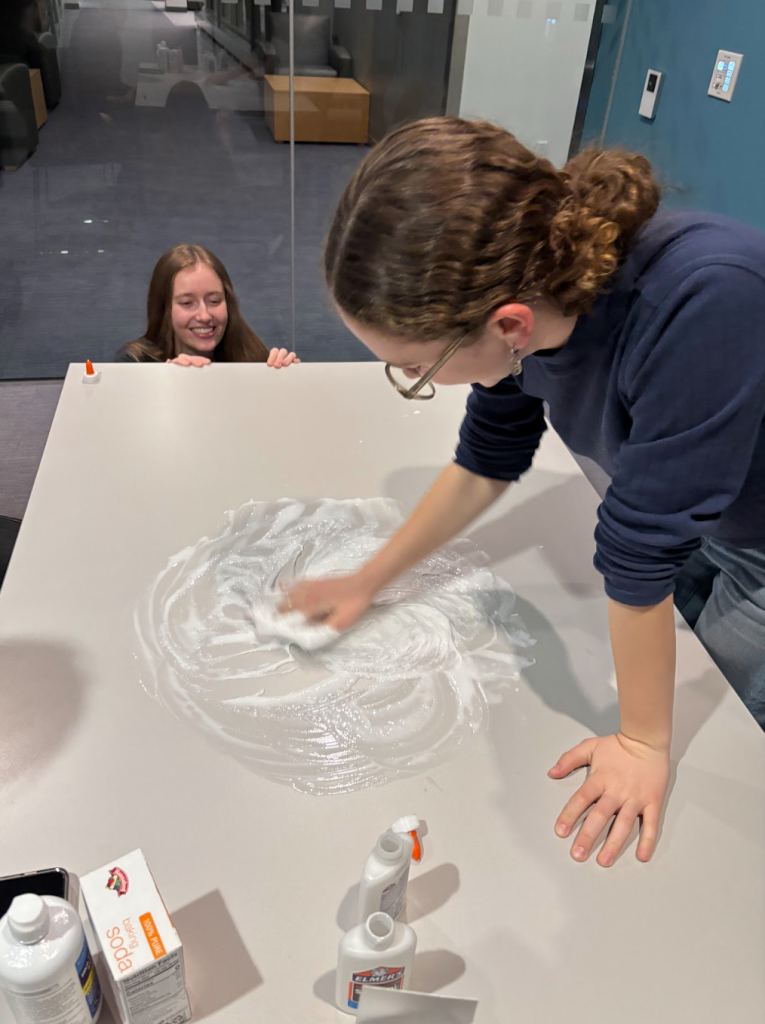
Researcher Linda Jack (left) watching as researcher Ella Richards (right) carries out the first activation attempt
Welcome to the Brandeisian Girls Club Blog!
If you are reading this, please help. Something terrible is happening at Brandeis. A great injustice has occurred, and YOU have the power to create change in your community. It all started a little under a year ago…
We are all familiar with the Usdan dining hall, located at the intersection of such notable establishments as the Hive, the mail room, and the Hoot (or as it is affectionately referred to, the c-store). By day, the Usdan dining hall is known for having lines worse than Disney World, but instead of a roller coaster at the end, you get a plate of overcooked cavatappi. All who enter the Usdan dining hall seem to find that they have suddenly lost all sense of direction and spatial awareness, as well as social cues, and must mindlessly bump into each other and block the limited thoroughfare of the already confusing layout. However, when the clock strikes eight, the gates close, and the staff begins to clean around you, desperately hinting that it’s time to leave, Usdan becomes an oasis of possibilities. It was on one such occasion that I and my close personal friend Linda Jack found ourselves to be the only remaining inhabitants of the once overcrowded dining hall. We could have left right then, gone home and called it a night. But Usdan had other plans for us. A mysterious spark of creativity seemed to pulse through the air, so Linda and I gathered our things and decided to explore the rest of the wider Usdan complex.
After six hours of deliberation and plotting in many of the scenic locations Usdan student center is host to, we found ourselves standing by the wall of posters at the top of the stairs leading down to the mail room. It was at this point, while looking through the posters for Brandeis organizations that we discovered something that sent a shiver down my spine: there were no feminist satire magazines on campus. Sure, there were other magazines, all with their own merits, but no magazines that were explicitly feminist and also a comedy magazine and also based on early 2000s kids magazines. So Linda and I knew what we had to do. It became our mission to start such a magazine at Brandeis and bring this school into the 21st century.
Over the next few months, we began planning articles and columns to write, recruiting people to join our revolutionary masterpiece, and working closely with the Student Union to organize ourselves as an official Brandeis club. We decided that our magazine would be a niche reference to 2000s kids magazines like the American Girl Doll Magazine and National Geographic Kids!, but about life at Brandeis for the average Brandeisian Girl. After all of this hard work, we presented our club to the Student Union for their consideration, and were DENIED, seemingly without reason. The rest of that day was a blur. The Brandeisian Girls Club Magazine… denied? Did they not think we were serious? Were we not organized enough? Did it have something to do with the fact that its two founders had never written an article in their lives nor had any part in any form of journalism? Surely a feminist satire magazine run by the two most trustworthy people on campus would have been approved in a heartbeat! Something just wasn’t adding up…
Despite this devastating setback, the Brandeisian Girls Club decided to persevere, and without the funding to print and circulate a physical magazine on campus, opted to create a website for the low cost of this $5 domain name. The Brandeisian Girls Club lives on as a blog, but we have no intention of giving up our dream of being in print. Here’s where you come in!
You are now being put under a permanently binding spell. By reading these words, you have been magically transformed into a Brandeisian GirlTM. You will regularly check back in on this blog for updated content. You will tell all of your friends to read it too. You will begin writing angry letters to the Student Union, and Arthur Levine himself, begging for this blog to be given club status. The spirit of the BGC commands you! Go forth and girl-ify the world!