

Abstract
This week our scientists at the Brandeisian Girls Club Institute for Mad Science, or BGCIMS, tackled the until now unsolved scientific question of “can you make slime on the skyline common room tables (no borax no bowl)?”.
Our hypothesis: Yes you CAN make slime on the table of a skyline common room without borax or a bowl.
It took work, it took dedication, it took genius problem solving, it took trial and error, but by God our team was able to make a breakthrough in this scientific field that will change the way we see slime at Brandeis.
Theoretical Introduction
The activity of “making slime” became extremely popular in 2016 and the trend quickly spread globally until everyone (but not their mothers) wanted in on the experience. Making slime typically involves mixing together polyvinyl acetate glue and borax to create an interesting fluid that can be joyous to play with. The characteristic texture of slime is created by the polymers in the glue being linked together to create larger polymers. Slime, however, did not stay simple for long. Since its introduction to the scientific community many daring scientists have asked questions like “can I add my shaving cream to slime?”, “what happens if I dump an entire bag of beads into slime?”, “what will happen if I leave my slime uncovered in a bowl overnight?”, or “can I add clay to slime and if so will the texture be nice?”. These questions lead to the discovery of fluffy slime, crunchy slime, iceberg slime, and butter slime respectively.
These types of additions, however, have never been the main frontier of slime science. Slime science has for its entire history been far more focused on the act of removing ingredients from slime and investigating the effects. Our team at BGCIMS has coined this type of investigation as “Reductive Slime Theory”.
Reductive Slime Theory arose mainly from the fact that many people did not have some specific ingredients like borax in their home. This led to a huge uptick in trying to make slime with as few ingredients as possible or with the most exotic ingredients they could find. On June 1st of 2016 over 1 billion people in the US alone Googled: “How to make slime no borax no glue”. This line of investigation directly catalyzed the discovery of other slime activators* that could be used in place of borax. This includes laundry detergent and contact solution.
The study of Reductive Slime Theory unfortunately also became infested with frauds. Due to the ease of falsifying YouTube videos, thousands if not millions of creators sought out to dupe real slimers with fake recipes based on no scientific truth. Slimers were fooled into believing, for instance, that putting shampoo and salt into a sealed container overnight would result in perfect slime by morning. Slime scientists as a result have been working tirelessly to combat the false claims spread by slime scammers since 2016.
Since the slime craze has cooled down in recent years, slime scientists have been able to focus less on false recipes and more on making new breakthroughs.
The question our scientists have been investigating has plagued slime scientists since the birth of Reductive Slime Theory. Can you make slime, not JUST without borax, but also without a bowl? I’m sure you too, dear reader, have been kept up at night by this question, but fret no more. The BGCIMS has found irrefutable scientific proof that you can in fact make slime without a bowl, without borax, on a table in a Skyline common room here at our home of Brandeis University. Stick around to find out exactly how.
Materials
To make the results of this experiment as clear as possible it was our aim to use only a few simple ingredients. This is of course the usual aim of Reductive Slime Theory. In our case, using few ingredients also was helpful in identifying the ingredient that caused the formation of slime, with too many ingredients it would have been impossible to determine what ingredients or processes were responsible for the results. In order to replicate this experiment the following materials are required.
- 48 ounces of polyvinyl acetate glue (purchased from Hannaford’s Supermarket and Pharmacy)
- 12 fluid ounces of contact solution containing boric acid (purchased from Hannaford’s Supermarket and Pharmacy)
- Baking soda
Methods and Results
i) Setup
The start of our work began by emptying one 16 ounce bottle of our Elmer’s PVA glue onto our sterilized work surface (the table in the Skyline common room). A key property of this work surface is that it is large enough in both length and width such that when the glue is poured completely out it does not spill over the edge. Even with a large table, it was initially necessary to assign one researcher to the task of keeping the glue on the table.
ii) Activation Attempt 1
With ⅓ of the glue supply emptied onto the work surface, the task became activating the slime. For this experiment our initial hypothesis was that contact solution would be sufficient to activate the slime. One researcher added a splash of contact solution to the work surface and the researcher in charge of mixing agitated the slime until the solution was homogenous. This did not have any significant result.
This addition of a small amount of contact solution followed by significant mixing was repeated approximately 7 more times. The only observation made by our mixing researcher was that the fluid would seem to begin to coagulate for a few moments before melting back into the puddle. This caused us to try adding significantly more contact solution rather than just a dash. We added large amounts of solution twice. This still did not cause a reaction in the glue.
At this point our team became divided. There were two schools of thought on the matter of the contact solution*. Either:
- We were adding too much contact solution causing the slime to be over activated.
Or:
- We simply had not added enough activator and it was only a matter of time until the slime formulated itself.
We will now take a short time to discuss these two theories. Proponents of the first theory argued that we had now added “a fuck load” of contact solution. The idea behind the over activation theory relied on the fact that contact solution is a known slime activator and it is also well documented that too much solution can cause slime to melt. Since it is a known activator, proponents of this theory argued that it was unlikely that it had simply not worked and was far more likely that we had melted the slime.
The second theory, ironically, also relied on the fact that contact solution is a known slime activator. Proponents of this school of thought argued that since the solution would normally activate the slime before reaching the saturation point that would lead to melting. It was argued that since the slime had not yet activated, it could not possibly be over activated. The theory one backers countered with the fact that the glue had been observed to coagulate so some activation had clearly occurred.
These two schools of thought were not immediately able to reach a consensus. They did, however, come together to plan the next step.
iii) Operation Add More Glue
The motivation behind Operation Add More Glue was that regardless of which theory was correct in explaining the lack of activation, more glue was sure to solve the problem. If theory 1 was correct, more glue would help balance out the incorrect ratio between activator and polyvinyl acetate. On the other hand, if theory 2 was correct, more glue would not hurt the process, more activator would just have to be added to compensate. Both groups of researchers then agreed to add another 16 ounce container of glue to the work surface.
This new ratio was mixed for a time in order to ensure it was completely combined with the original glue and contact solution mixture. This mixing did not have any results.
Now that the threat of over activation had been successfully neutralized, our team gathered to discuss how to move forward in order to avoid the same problem occurring again. (This meeting of course did not include the team member responsible for keeping the glue on the table).
To move forward, our team made the potentially controversial decision to make a change and try a different activator. It was decided that we had determined that the contact solution had not been sufficient to activate this slime. Though we did not discover the exact reason for this failure, it was determined that it was more important for the success of this experiment that we stop backing a dead horse and move down a different path.
iv) The Search for a New Activator
Our team at this point brainstormed options for a different active ingredient. Laundry detergent was mentioned but discarded because it is expensive and no one on our team was willing to give up their detergent for this mad science mission.
At this crucial moment it was discovered that one of our researchers was in possession of a nearly full box of baking soda. This baking soda originated from an extra credit project assigned by Prof. Claudia Novak. Its original use was to be used to demonstrate the three gas laws. That little box of baking soda was about to take part in a 2nd scientific experiment. This was our new activator.
Our scientists decided to make the risky choice of using baking soda even though it has less peer reviewed slime recipes than contact solution.
v) Activation Attempt 2
Our scientists returned to the puddle of glue and sprinkled a tiny bit of baking soda into the fluid. The main goal here was to avoid over activation at all costs so this process was completed very slowly.
As soon as that pinch of baking soda was mixed in, the properties of the mixture altered significantly. Once fully mixed, the slime mostly returned to its original consistency. Just like in titration, this showed our team that the correct chemical process was occurring but more baking soda would be needed in order to react the entire 32 ounces of glue currently on the table.
More baking soda was added in tiny increments split up by lots of mixing until our mixture began to take shape as slime.
vi) Operation Add Even More Glue
It was clear at this time that the slime would come together as long as our ratios remained correct. Due to this, our team decided to add even more glue by pouring in our final 16 ounce bottle of glue. There was now a total of 48 ounces of glue on the Skyline common room table. After this, we continued to slowly add baking soda to achieve the slime texture we desired.
vii) Kneading
Once slime begins to take shape it is important to immediately stop adding activator and knead the slime. This is vital because slime that is perfectly activated will often be sticky and only needs to be handled to lose its sticky nature. It is a common misconception that more activator will get rid of stickiness. Adding more activator at this stage will only result in non stretchy slime that does not last. At this stage, the slime was kneaded until it became the desired consistency.
Thus our experiment was a success. Slime was made without borax or a bowl.
Results
In this experiment it was found conclusively that slime can be made without a bowl and without borax. One major result of our work was that contact solution is in fact a difficult activator to work with that is not to be trusted. However, due to the ingenuity of BGCIMS, a total of 48 +/- 2 ounces of slime was created. The texture of this slime did leave something to be desired however, it was not very stretchy. We recommend to scientists looking to peer review this work that the kneading step be started earlier and less baking soda be added. We also recommend that this experiment be repeated without any contact solution. This would isolate the variable of baking soda and once and for all ensure that it was in fact the baking soda that had the desired effect of activating the slime.
Future Work of BGCIMS
Reductive Slime Theory is only one of many areas of study at The Brandesian Girls Club Institute for Mad Science. We encourage you to keep up to date with the cutting edge work occurring daily at this institute. Tune in next time for the answers to burning questions like “what are the effects of adding tequila to c-store milk?”
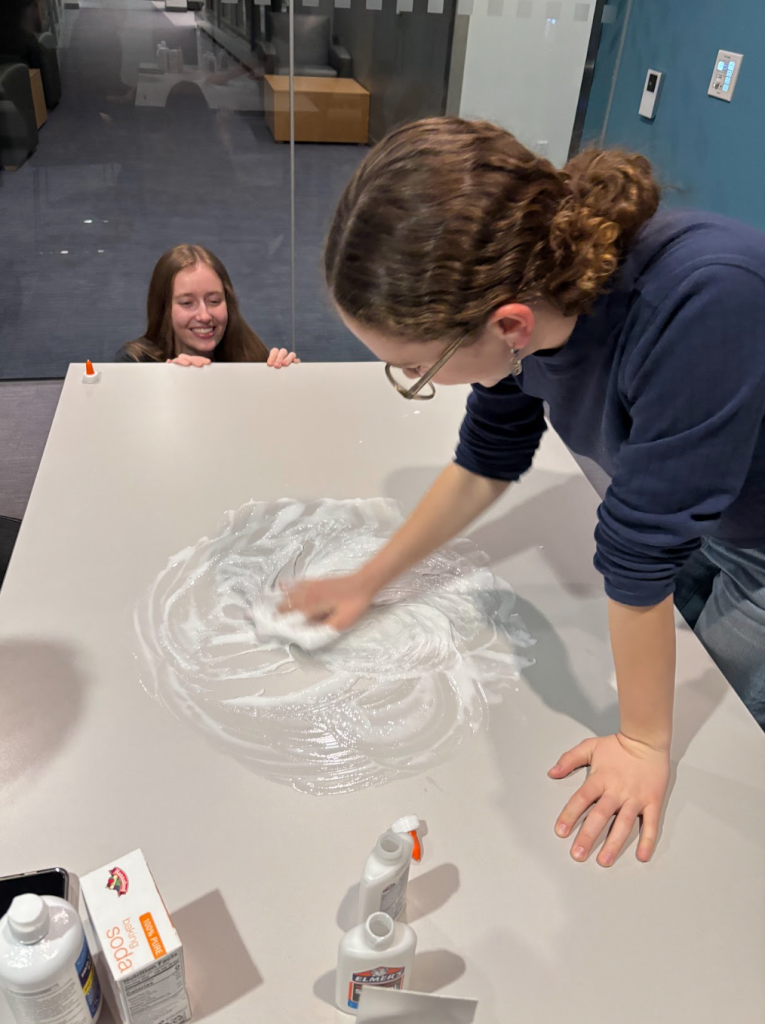
Researcher Linda Jack (left) watching as researcher Ella Richards (right) carries out the first activation attempt